
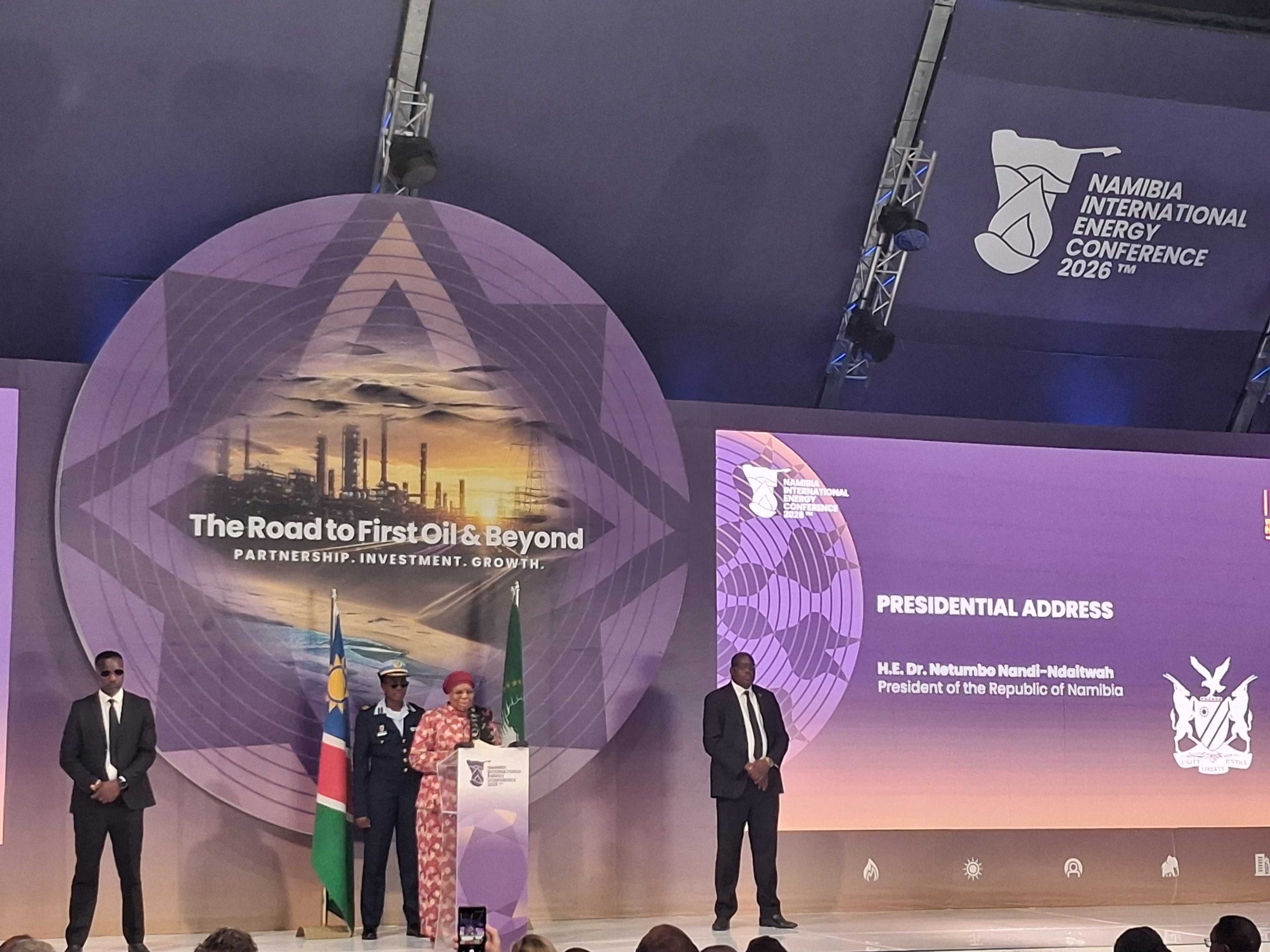
Namibia’s President Dr. Netumbo Nandi-Ndaitwah has announced a major push to accelerate petroleum reforms, including progress on a Petroleum (Exploration and Production) Amendment Bill, as the country moves to fast-track governance and investment frameworks ahead of first oil. Speaking at the Namibia International Energy Conference (NIEC) 2026 in Windhoek on Wednesday, the President said the reforms are central to improving regulatory efficiency, strengthening investor confidence and ensuring that the country’s emerging offshore oil sector delivers broad-based national benefits.
The announcement comes as Namibia intensifies efforts to convert its Orange Basin discoveries into production, with policymakers and industry leaders emphasizing that legal and institutional readiness must keep pace with accelerating upstream activity. The reform agenda is aimed at streamlining decision-making, improving sector coordination and aligning the country’s hydrocarbons strategy with Vision 2030, as major operators advance exploration, appraisal and development planning across multiple deepwater assets.
“As Namibia stands on the cusp of a new chapter of development, we are here not only to reflect on progress, but also shape the path ahead,” President Nandi-Ndaitwah said. “The road to first oil and beyond requires investment and partners for development to be realized. Hence the need for strategic reform to give confidence to investors and citizens alike.”
The emphasis on collaboration and policy certainty was echoed throughout the NIEC Opening Ceremony, where African Energy Chamber – Strategic Partner for NIEC 2026 – Executive Chairman NJ Ayuk described Namibia’s recent exploration success as a historic shift in global perception. He argues that the country’s challenge is no longer discovery, but execution – ensuring that legislation, investment conditions and talent development keep pace with accelerating offshore activity.
Ayuk highlighted that Namibia is now competing directly with other emerging hydrocarbon hubs for global capital, urging policymakers to sustain momentum and unlock broader participation in the sector. He said the country’s growing resource base presents a major opportunity to address energy poverty while building a competitive upstream industry.
“Namibia is a country where it was very difficult to find discoveries,” Ayuk said. “But right now, you get some of the biggest discoveries. And who can complain about Namibia becoming the drill, baby, drill capital of Africa? Namibia deserves to use every drop of hydrocarbons to better the lives of its people. We need to pass the right legislation to empower this government to fast-track opportunities. Namibia’s aspirations can be done by the work we do in this room. Energy poverty is real, and our industry is called upon to meet this challenge.”
Stressing that Namibia’s first oil is “not the destination, but the beginning,” Ndapwilapo Selma Shimutwikeni, CEO of NIEC organizer RichAfrica Consultancy emphasized that resource wealth alone will not transform the economy. She said real value will come from building surrounding industries, expanding local business participation and ensuring collaboration between investors and government to create inclusive, long-term economic development.
“Namibia stands at the threshold of its first oil. The success of Namibia’s energy sector will not be measured only by production but by how broadly it supports wider development, collaboration and the role of businesses and entrepreneurs. Collaboration is not optional. It is essential. The scale of opportunity requires trust between investors and collaboration between international companies and local government,” Shimutwikeni said.
That emphasis on collaboration and trust between investors and government is already translating into concrete upstream activity, with major operators accelerating their exploration programs across Namibia’s Orange Basin. Energy major Chevron confirmed that the company will drill the Nabba-1X exploration well in late-2026, marking a key step in its expanding Namibian portfolio and reinforcing confidence in the basin’s long-term deepwater potential.
“Chevron is moving to the next phase of our exploration journey,” said Beatrice Bienvenu, Namibia Country Manager, Chevron International Exploration & Production, adding that the decision reflects confidence in the basin’s emerging deepwater discoveries and the country’s growing position as a globally competitive frontier for exploration investment.
Meanwhile, momentum across Namibia’s Orange Basin is also being reinforced by parallel upstream advances from key operators, with activity shifting decisively from discovery toward development. Rhino Resources announced it is preparing to drill the Capricornus well in the coming months, while TotalEnergies is progressing its Venus development toward a mid-2026 final investment decision. These milestones are expected to be a catalyst for large-scale production and further development across its Namibian portfolio.
Together, these milestones underscore Namibia’s rapid transition from exploration frontier to emerging production hub, with the Orange Basin increasingly viewed as one of the most significant new deepwater plays globally.
