
Africa’s energy transition is often framed around decarbonization targets. But across much of the continent, the immediate challenge is more basic: building power systems capable of supporting industrial growth while expanding electricity access. For African economies, the question is not simply how to replace existing energy sources, but how to add large volumes of reliable, low-carbon power without constraining development.
For the African Energy Chamber (AEC), this balance sits at the core of a just transition. Africa contributes less than 4% of global greenhouse gas emissions, yet faces pressure to decarbonize while still building the infrastructure needed to power factories, mines, transport systems and rapidly growing cities. Energy systems designed for advanced economies cannot simply be replicated on a continent where more than 600 million people still lack reliable electricity.
This reality also complicates the notion that Africa can leap directly to a fully renewable energy system. Solar and wind are expanding rapidly, but their intermittency means large-scale storage and grid upgrades are needed. For many African countries, a 100% renewables pathway remains technically and financially out of reach in the near term.
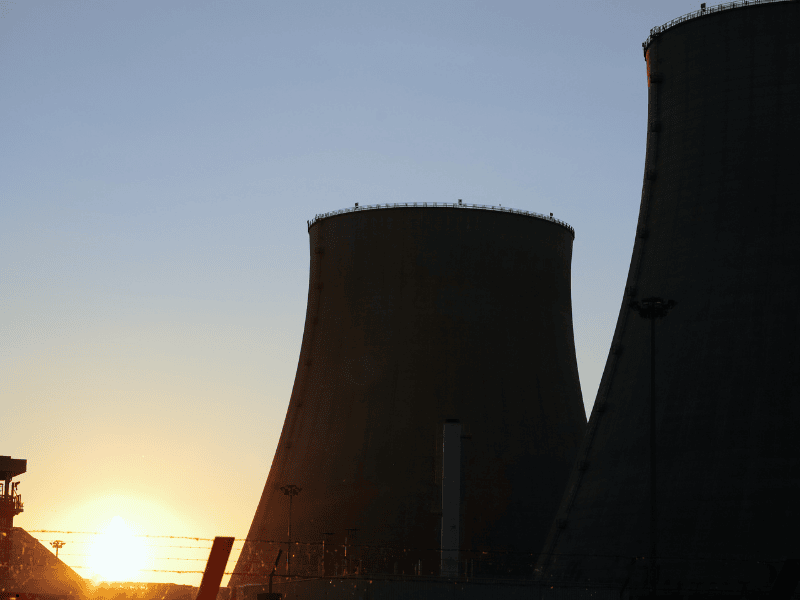
Reliable baseload power is essential for industrial development – nuclear energy offers one pathway to close this gap. Unlike solar and wind, nuclear plants operate continuously and produce large volumes of electricity with no direct carbon emissions. Their long operating lifetimes and high output make them well suited to supporting industrial economies while helping countries meet climate commitments.
Several projects illustrate how nuclear could fit into Africa’s evolving energy mix. In Egypt, construction is underway at the El Dabaa Nuclear Power Plant, a $30 billion development being built with Rosatom. The facility will include four reactors with a combined capacity of 4.8 GW and is expected to provide roughly 10% of Egypt’s electricity once operational, while supporting domestic supply chains and workforce development.
In South Africa, nuclear power already plays a central role through the Koeberg Nuclear Power Station, Africa’s only commercial nuclear facility. The two-reactor plant generates approximately 1,860 MW of baseload electricity and remains a cornerstone of the national grid. In November 2025, regulators approved a 20-year operating licence extension for Koeberg’s Unit 2, allowing it to run until 2045 following extensive refurbishment and safety upgrades. The government is also advancing plans to procure around 2,500 MW of new nuclear capacity as part of its long-term energy strategy, reinforcing nuclear’s role alongside renewables and natural gas in stabilizing the power system and supporting economic growth.
Senegal is emerging as another key example of Africa’s nuclear ambitions, integrating the technology into its long-term Vision Senegal 2050 and targeting a threefold expansion of nuclear capacity by mid-century. The country has already established a nuclear research reactor and is preparing for the deployment of a small modular reactor (SMR) to provide reliable, low-carbon baseload power for industry and communities. Speaking at African Energy Week 2025, Cheikh Niane, General Secretary of the Ministry of Energy, Petroleum and Mining, emphasized the broader role of nuclear energy for Africa’s development.
“Nuclear is not only about electricity; it builds scientific capacity, engineering expertise and technological sovereignty, equipping our continent to compete globally,” said Niane. “We invite our African brothers and sisters to join us on this path so that Africa does not once again stand behind, but at the forefront for global progress.”
Governments in Ghana, Namibia and Niger are also exploring nuclear development as part of their long-term energy strategies, while emerging technologies such as SMRs are gaining attention for lower-cost, faster deployment. At the continental level, cooperation is expanding. In early 2026, the African Union, the African Commission on Nuclear Energy and the OECD Nuclear Energy Agency signed a memorandum of understanding to strengthen technical collaboration and regulatory capacity for the peaceful development of nuclear energy across Africa.
These developments reflect a broader shift toward pragmatic energy planning. Rather than pursuing an idealized single-technology pathway, many African countries are now considering diversified energy systems that combine nuclear, natural gas and renewable power. Gas can provide flexible generation to support industry and economic activity; renewables can expand clean electricity where resources allow; and nuclear can deliver the steady baseload capacity needed to maintain grid stability.
“Too often Africa’s energy transition is discussed as if the continent has the same starting point as Europe. It does not. Hundreds of millions of Africans still need electricity, and industries that create jobs require reliable power every hour of the day. Nuclear energy gives African countries a way to lower emissions while still building the kind of power systems that support industrial growth and economic development,” says NJ Ayuk, AEC Executive Chairman.
For Africa, achieving net zero will require an approach grounded in economic realities as well as climate goals. A balanced mix of nuclear, gas and renewables offers a path to expand electricity access, support industrial growth and reduce emissions – ensuring that the continent’s energy transition leaves no community in the dark.
