
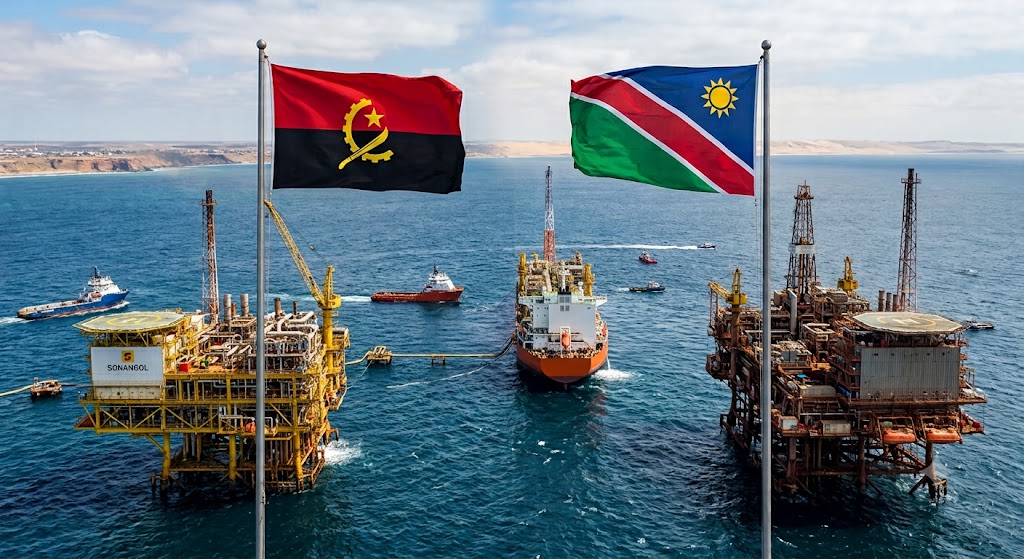
Namibia has emerged as one of the world’s most promising frontier oil and gas markets, with multi-billion-barrel discoveries positioning the country for first production by 2030. Yet moving from discovery to commercial production requires more than resource potential. It requires an investment framework that provides fiscal certainty, reduces execution risk and enables long-term capital deployment at scale.
Angola offers one of Africa’s clearest examples of how targeted upstream reform can reshape an entire sector. These lessons are explored in Crude Oil: Power, Turnaround and Transformation in Angola by NJ Ayuk, Executive Chairman of the African Energy Chamber (AEC), now available globally. The book highlights how policy and fiscal reforms repositioned Angola from a declining producer to one of Africa’s most competitive upstream investment destinations.
Reform That Reset Angola’s Upstream Sector
Following years of production decline, Angola launched a wide-ranging reform program aimed at revitalizing both mature and frontier assets. In 2018, production had fallen by around 20% after an extended period without new licensing rounds, while imports accounted for roughly 80% of refined petroleum demand.
Today, that trajectory has shifted. Angola has attracted approximately $70 billion in planned upstream investment, supported by renewed exploration activity and a wave of offshore project developments. Key milestones include the $5.1 billion Greater PAJ development, which reached FID in 2026, alongside the Begonia and CLOV Phase 3 projects, both of which entered production in 2025. The Agogo FPSO is now onstream, while the Kaminho development is targeting first oil around 2028.
Exploration momentum is also accelerating, with TotalEnergies, ExxonMobil and Shell securing new acreage in Benguela and Namibe, alongside continued onshore activity from independents such as Afentra, Corcel and Etu Energias. Together, these developments reflect improved investor confidence in Angola’s regulatory and fiscal environment.
From Reform to Investment Certainty
Angola’s turnaround was not driven by geology alone, but by a deliberate shift in the quality and predictability of its investment framework. Since 2018, the country has introduced structural reforms including the Natural Gas Law, Gas Monetization Law, Permanent Offer framework and Marginal Fields legislation, all of which streamlined licensing procedures, improved fiscal competitiveness and strengthened long-term visibility for investors.
Crucially, these reforms embedded the core conditions that underpin upstream capital allocation decisions. Investors gained greater fiscal certainty through more predictable tax and royalty regimes, while stabilization clauses provided contractual protection against unilateral fiscal or regulatory changes over the life of projects. At the same time, approval and permitting processes were streamlined to reduce delays between discovery, FID and production, improving execution speed across the upstream value chain. These reforms were reinforced by stronger institutional continuity within the regulatory system, helping preserve technical expertise and ensure more consistent decision-making across policy cycles.
The 2018 Natural Gas Law established a dedicated framework for gas investment, unlocking monetization opportunities across Angola’s estimated 11 trillion cubic feet of reserves. The Permanent Offer mechanism, introduced in 2021, further improved market efficiency by enabling continuous licensing outside formal bidding rounds, reducing negotiation timelines and improving the flow of new opportunities to investors. Angola also introduced the Incremental Production Initiative to extend the life of mature fields and unlock stranded reserves, a framework expected to recover around 500 million additional barrels and extend field life cycles by up to two decades, significantly improving project economics and lowering investment risk.
A Blueprint for Namibia’s Next Phase
Namibia faces a similar but distinct challenge. While its discoveries have positioned it as a major frontier basin, sustaining investment beyond first oil will depend on embedding a bankable regulatory framework anchored in fiscal certainty, stabilization mechanisms and fast, transparent permitting systems that enable rapid project execution. Angola’s experience demonstrates that beyond fiscal incentives alone, execution speed and regulatory predictability are equally decisive in determining whether discoveries are converted into producing assets.
Equally important is institutional continuity within regulatory bodies, ensuring that technical expertise and administrative capacity are retained across policy cycles. This continuity helps reduce uncertainty for investors and supports more efficient project approval processes, both of which are critical in capital-intensive upstream environments.
Angola has also strengthened domestic participation through its Local Content Law, introduced in 2020. This has supported the emergence of indigenous companies such as Etu Energias and CABSHIP, which now play an increasingly important role across the value chain. Etu Energias alone has executed nearly $1 billion in M&A activity between 2022 and 2025 and is targeting 80,000 barrels per day by 2030, underscoring the importance of local operators in sustaining production growth and reducing operational risk.
Policy Certainty Drives Capital
As Namibia approaches first oil, Angola’s experience underscores a central principle: geology attracts attention, but predictable and enforceable policy frameworks attract capital. Stable regulation, transparent licensing, competitive fiscal regimes, stabilization clauses, efficient permitting systems and institutional continuity collectively determine whether upstream potential is converted into long-term production.
“Angola’s resilient and investor-friendly regulatory framework has attracted sustained investment across exploration, brownfield redevelopment and new offshore projects,” states Ayuk. “For Namibia, the opportunity is to build on its world-class discoveries by embedding the fiscal certainty, stabilization clauses and institutional capacity that give investors confidence to commit long-term capital.”
With global competition for upstream investment intensifying, Angola offers a practical roadmap for frontier producers. By combining resource potential with predictable, enforceable and efficiently administered policy frameworks, Namibia can accelerate its transition from exploration success to sustained production, deeper local participation and long-term economic growth.
