
After more than a decade of falling crude output, Angola is beginning to reverse the trajectory that once threatened its status as one of Africa’s largest oil producers. Production has stabilized at around 1.1 million barrels per day (bpd), supported by offshore developments, exploration campaigns and one of the continent’s most aggressive upstream reform programs.
The recovery is being engineered through structural reforms, new licensing policies and targeted incentives aimed at unlocking capital in mature and frontier acreage. Today, the country is pursuing what has become a roughly $70 billion upstream investment drive, anchored by international majors, large-scale offshore projects and a regulatory framework designed to improve long-term competitiveness.
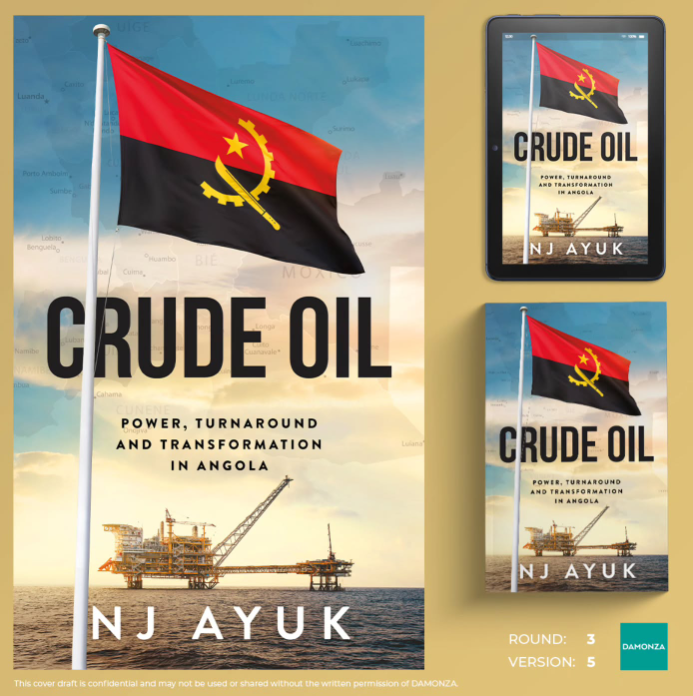
These themes are examined in detail in Crude Oil: Power, Turnaround and Transformation in Angola by NJ Ayuk, now available globally. The book outlines how Angola moved from production decline and investor hesitation toward a renewed growth cycle by restructuring institutions, reforming petroleum legislation and repositioning itself as a more competitive upstream market.
Structural Reform Has Reshaped the Sector
To curb production decline and attract renewed investment in exploration and brownfield development, Angola instituted a series of reforms since 2018 aimed at improving fiscal terms. Major reforms included the establishment of both an upstream and downstream regulator – the National Oil, Gas & Biofuels Agency (ANPG) and Instituto Regulador dos Derivados do Petróleo (IRDP) –; the launch of a multi-year licensing strategy; the introduction of Risk Service Contracts; and the restructuring of national oil company Sonangol.
New policies introduced by the government include the Incremental Production Decree, Gas Monetization Law and Marginal Field Law. Updated versions of the National Development Plan introduced in 2018 and 2023 offered a roadmap to improve the country’s socioeconomic development, focusing on reducing hydrocarbon production decline while stimulating other sectors of the economy.
The Next Offshore Growth Cycle is Already Underway
Several offshore projects in Angola are strengthening output and demonstrating the viability of offshore investments. These include the TotalEnergies-led Begonia and CLOV Phase 3 developments – brought online in 2025 with a combined capacity of 60,000 bpd – and the Azule Energy-led Agogo Integrated West Hub development – progressing toward full capacity following the Agogo FPSO commissioning in 2025 and Ndungu field startup in 2026. The $6 billion TotalEnergies-led Kaminho project is progressing toward a 2028 start, targeting 70,000 bpd at Block 20/11.
Beyond projects, international operators are backing the market with capital commitments. TotalEnergies plans to invest $3 billion in the coming years, while Azule Energy is planning to invest $5 billion. ExxonMobil previously indicated it could inject as much as $15 billion into the market following successful drilling in the Namibe basin. While initial probes were deemed uncommercial, the move showcases the level of interest in Angola’s frontier basins.
Onshore Exploration Gains Renewed Momentum
Angola’s onshore basins are also moving back toward production after decades of inactivity. Several independents are leading exploration in the Kwanza and Lower Congo inland basins, with drilling campaigns underway following Angola’s 2023 licensing round which offered 12 onshore blocks.
Corcel is conducting seismic studies at KON 16 with an exploration well planned in 2026/2027; Oando entered the market with operatorship of KON 13 in 2026; Sonangol is leading exploration efforts at KON 11, KON 12 and KON 15; while Etu Energias is advancing seismic research at FS, FSST, CON 4 and CON 1. Other companies including Walcot Energy and ACREP have strengthened their presence across the market.
These moves showcase a market responding to directly to reform. They also demonstrate that Angola’s upstream recovery is no longer being framed around decline management – but rather on long-term production growth.
