
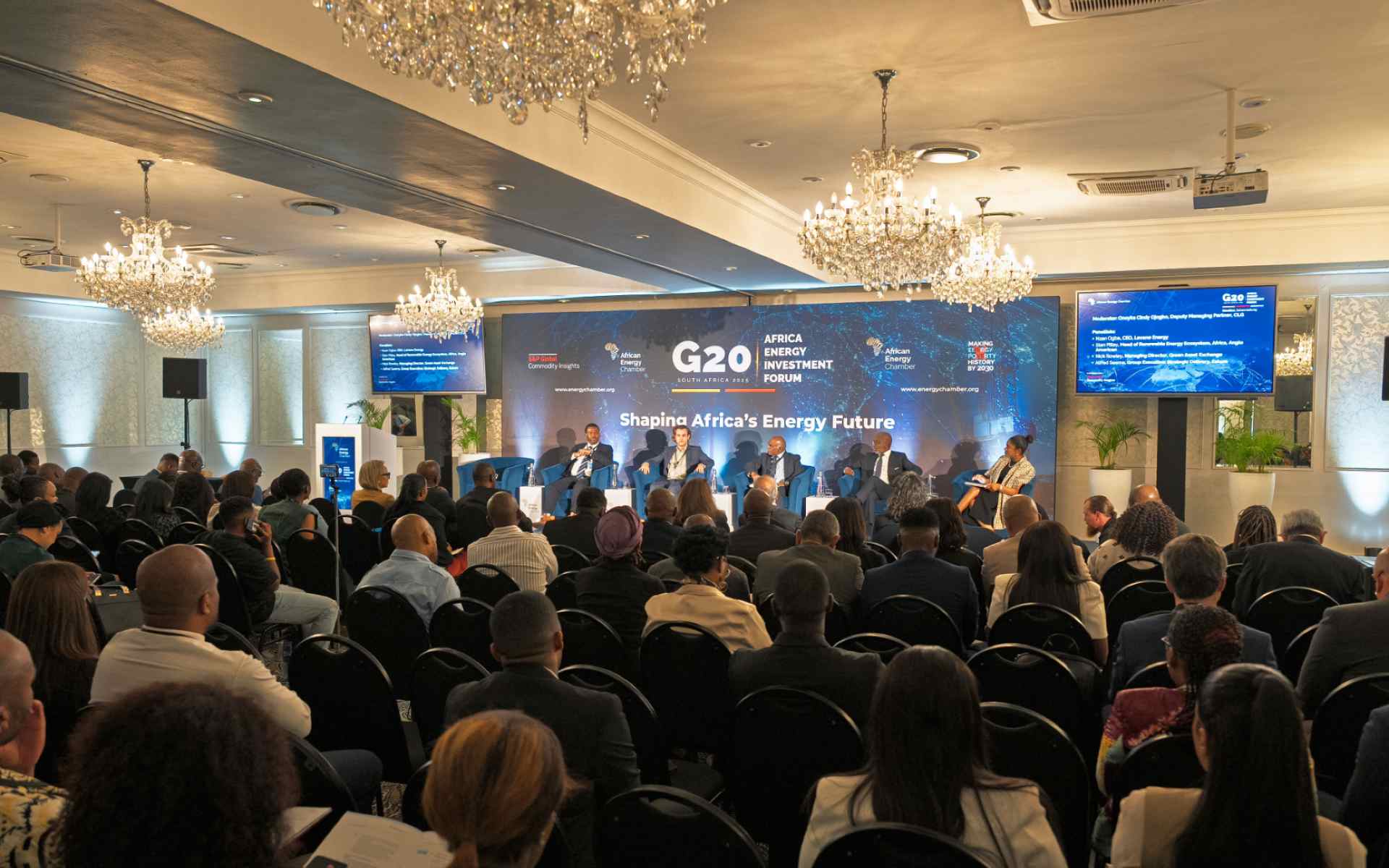
African energy executives and policymakers urged a shift toward blended financing, durable policy frameworks and stronger public-private coordination to accelerate power generation and stabilize national grids across the continent.
Speaking at a high-level panel during the G20 Africa Energy Investment Forum in Johannesburg, leaders emphasized that Africa’s path to future-ready energy systems depends on leveraging both hydrocarbons and renewables, while building domestic capacity in AI, digital infrastructure and advanced manufacturing.
“Investment cannot be binary. Funding needs to be blended – governments, local banks and international partners must come together,” stated Nzan Ogbe, CEO of energy services solutions provider Levene Energy.
Levene Energy operates a 100 MW solar PV manufacturing plant in Nigeria – the first privately owned, full automated facility of its scale in the country. Ogbe explained that the company had to self-fund the plant after repeated challenges securing ESG-aligned capital, underscoring that Africa’s energy transition cannot rely on narrow or siloed financing models.
For mining giant Anglo America, blended structures have already unlocked progression for its joint venture with EDF, Envusa Energy, enabling large-scale PV, wind and inter-generation projects aimed at managing power costs and reducing emissions.
“The non-negotiable is that we need a stable grid,” Stan Pillay, Regional Carbon and Innovation Lead-Africa, Anglo American stated, adding, “With a stable grid, we can reduce the cost of power to our operations, we could help stabilize the national grid and we could decarbonize.”
Anglo American is currently developing a multi-site renewables portfolio in South Africa designed to power its operations and support its goal of carbon neutrality by 2040.
Panelists further highlighted the rising importance of green assets – including carbon credits and renewable energy certificates – in improving financing terms for early-stage energy developments.
“We must use every resource at our disposal to unlock capital,” stated Nick Rowley, Managing Director for online marketplace firm Green Asset Exchange, adding, “There is no shortage of projects – there is a shortage of finance that meets developers where they are.”
Concluding the session, Alfred Seema, Group Executive for South African energy company Eskom underscored that credible investment will not materialize without durable policy frameworks that balance baseload stability with cleaner generation and support regional grid integration.
“Without proper policies, we cannot attract credible investment. Policy certainty is what allows us to fast-track energy delivery,” Seema said.
