
Namibia’s evolving Gas Master Plan places natural gas at the heart of its industrialization agenda, aligning policy with major offshore discoveries in the Orange Basin. With production potentially exceeding 2.5 million tons annually, the plan integrates resources from Venus, Mopane and Kudu to transform Namibia into a regional energy hub by decade’s end.
The African Energy Chamber (AEC) wholeheartedly supports Namibia’s strategic focus on gas monetization, emphasizing the need for balanced domestic utilization and export-driven growth. The Chamber underscores that clear regulatory frameworks, bankable projects and infrastructure investment will be key to unlocking long-term value across gas markets.
“Over 600 million Africans across the continent don’t have access to electricity. One billion don’t have access to clean cooking. One million die every year to inadequate indoor air quality. We need to fix that. Our industry is called upon to meet this challenge. Namibia starts right now at a crossroad, and the country deserves to use every drop of hydrocarbons to better the lives of its people,” says NJ Ayuk, Executive Chairman, AEC.
Namibia’s monetization strategy centers on a dual-track approach: gas-to-power for domestic security and selective export pathways for revenue generation. Developing the Kudu gas field to deliver an initial 420 MW – scaling to 800 MW – could eliminate over half of Namibia’s electricity imports while anchoring a stable baseload for industrial growth. Beyond power generation, gas is being positioned as a critical industrial feedstock. Plans to channel supply into fertilizer and petrochemical production aim to stimulate manufacturing, reduce import dependence and create downstream industries. This approach reflects a broader shift from resource extraction toward value-added industrialization within Namibia’s borders.
At the regional level, Namibia is exploring electricity exports as a higher-value alternative to raw gas sales. With infrastructure constraints limiting pipeline economics, converting gas into power for the Southern African Development Community offers a competitive pathway, potentially positioning Namibia as a stable electricity supplier in Southern Africa.
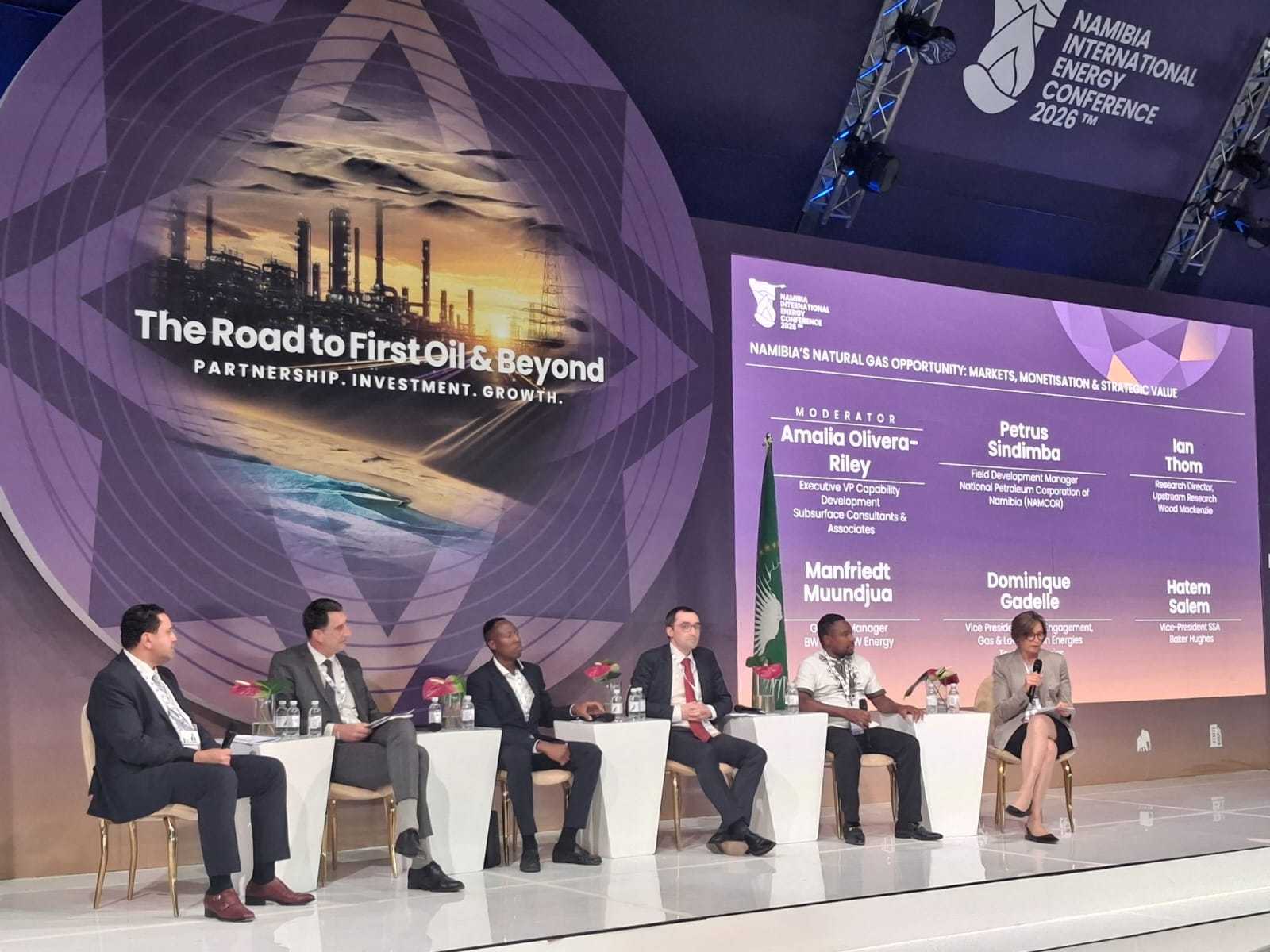
Insights shared during the Namibia International Energy Conference in Windhoek – where the AEC is a Strategic Partner – reinforced the complexity of this transition. Petrus Sindimba, Field Development Manager for Namibia’s national oil company NAMCOR highlighted that Namibia’s success will hinge on flexible monetization strategies, including offshore FLNG solutions and pipeline-fed gas-to-power projects capable of delivering up to 800 MW.
From a technical and commercial standpoint, Dominique Gadelle, Vice President-Early Engagement, Gas & Low Carbon Energies at Technip Energies emphasized that gas-to-power represents the most practical near-term solution. He pointed to its relative simplicity compared to complex export structures, positioning it as a catalyst for scaling Namibia’s broader gas value chain, including future LNG and cross-border opportunities.
However, execution challenges remain, with Ian Thom, Research Director: Upstream Research at Wood Mackenzie noting that the pathway to first has differs significantly from oil, requiring distinct infrastructure, pricing models and timelines. This underscores the importance of early planning, coordinated investment and realistic project sequencing across Namibia’s gas developments.
Regulatory alignment is also critical. According to Manfriedt Muundjua, General Manager at BW Energy, while the Gas Master Plan signals intent, it must be supported by harmonized legislation. This includes updates to the Petroleum Act and a dedicated gas bill addressing downstream pricing and market structures.
Industry stakeholders further highlighted the importance of economic viability. Hatem Salem, Vice-President for Sub-Saharan Africa at Baker Hughes, emphasized that successful gas monetization depends on strong project economics, stakeholder alignment and realistic development strategies – particularly in a competitive global energy market.
Strategically, Namibia’s gas ambitions extend beyond revenue generation. Under national development targets, gas production of 130 million standard cubic feet per day by 2030 could create over 22,000 jobs while strengthening energy security. Gas-fired baseload power will complement renewables, ensuring gid stability as Namibia scale solar and wind capacity. Projects like the Kudu gas-to-power development illustrate this integrated vision. Leveraging offshore reserves of 1.3 trillion cubic feet, the project will combine subsea infrastructure, a floating production unit and a 170-km pipeline to supply a planned 800 MW power plant – phased to address immediate domestic demand.
Ultimately, Namibia’s natural gas opportunity lies in its ability to balance domestic impact with export potential. With strong policy direction, growing investor interest and coordinated execution, the country is well-positioned to convert its gas resources into a cornerstone of long-term economic transformation and regional energy leadership.
