
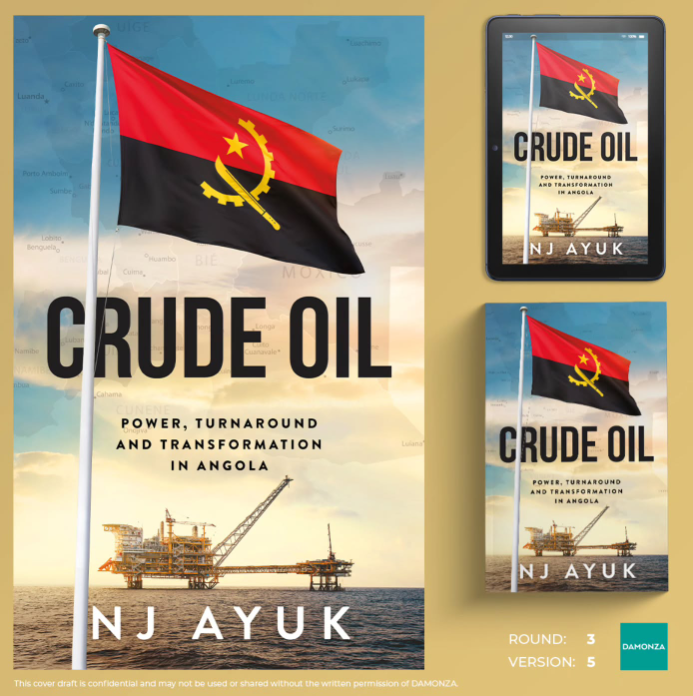
Published by Made for Success Publishing, Crude Oil: Power, Turnaround and Transformation in Angola is an approximately 260-page examination of Angola’s political evolution, energy sector, economic reforms and future ambitions. The book blends political history, industry analysis and firsthand insights from key decision-makers to show how Angola has repositioned itself as one of Africa’s most resilient oil and gas markets.
Structured across eleven chapters, the book combines history, policy, economics and human resilience into a sweeping account of how one African nation is attempting to transform resource wealth into long-term national renewal.
What makes the work particularly compelling is that NJ Ayuk does not merely tell the story of Angola’s oil industry; he tells the story of a country trying to redefine itself after decades of war, corruption, economic dependence and missed opportunities. In many ways, Angola becomes the lens through which Ayuk explores a broader African reality — a continent blessed with immense natural wealth, yet still struggling to convert resources into widespread prosperity.
The book’s structure deserves recognition because it reflects serious discipline and long-form storytelling craft. Ayuk resists the temptation to jump immediately into oil production statistics or investment deals. Instead, he starts at the beginning: the land itself. The opening chapters explore Angola’s geography, demographics, geology and natural resources before moving into Portuguese colonialism, the slave trade and the wars that shaped modern Angola. The sequencing matters because by the time the reader reaches the modern oil economy, Angola no longer feels like just another petroleum-producing nation. It feels layered, wounded, resilient and historically grounded.
Ayuk’s sections on geology are surprisingly engaging. He explains how Angola’s offshore basins, ancient rock formations and kimberlite structures helped shape the country’s oil, gas, diamond and mineral wealth. Rather than sounding overly technical, these chapters read like foundational storytelling, helping readers understand why Angola matters strategically not just to Africa, but to the global energy system.
The historical sections are among the strongest in the book. Ayuk traces Angola’s evolution from colonial exploitation and slave trading to civil war and post-conflict reconstruction. There is emotional weight in these chapters because they quietly remind readers how much Angola endured before becoming one of Africa’s leading oil producers.
At several points, the reader gets the sense that Angola’s survival itself is part of the story.
That emotional texture strengthens the book considerably. Ayuk writes not only about pipelines, reforms and production targets, but also about endurance. The Angola that emerges from these pages is a nation that absorbed decades of conflict and instability yet continued pushing toward reinvention.
The prose itself is readable and accessible throughout. Although the book is filled with figures, policy discussions and institutional analysis, it rarely feels dense or academic. Ayuk writes with the rhythm of someone accustomed to speaking to investors, policymakers, conference audiences and ordinary Africans alike. The tone moves comfortably between storytelling, advocacy and analysis.
Importantly, the book never becomes trapped in technocratic language. Even when discussing petroleum laws, fiscal reforms or gas monetization strategies, Ayuk keeps the writing conversational enough for non-specialist readers to remain engaged. The result is a book that can appeal both to energy professionals and to readers simply interested in African political economy.
Ayuk also balances advocacy with reporting more effectively than many readers may initially expect. His support for African energy development is unmistakable, but he does not entirely avoid Angola’s difficult realities. Corruption, overdependence on oil, governance failures, production decline and economic pressure all receive serious attention. Yet Ayuk writes from the perspective of someone who believes reform and transformation are possible rather than inevitable failures waiting to happen.
That optimism becomes one of the defining characteristics of the book. Ayuk approaches Angola not simply as a case study, but as proof that African countries can still reshape their trajectories through policy reforms, strategic leadership and resource management. Early in the book, he frames Angola as a possible blueprint for other African nations seeking to overcome energy poverty.
That idea effectively becomes the book’s central argument.
Ayuk’s authority on the subject strengthens the work significantly. As Executive Chairman of the African Energy Chamber — widely regarded as the continent’s leading energy advocacy organization and policy voice — Ayuk has spent years unapologetically championing African ownership of African resources and defending the continent’s right to develop its oil and gas reserves in pursuit of industrialization, energy access and economic sovereignty.
He is also founder of Centurion Law Group, now CLG, one of Africa’s leading legal and advisory firms focused on energy, infrastructure and extractive industries, with a sprawling and steadily growing presence across more than a dozen African countries, as well as expanding operations and partnerships in Europe, the Middle East and the Americas.
This is also not his first major contribution to the debate. His previous books include Big Barrels: African Oil and Gas and the Quest for Prosperity, Billions at Play: The Future of African Energy and Doing Deals, and A Just Transition: Making Energy Poverty History with an Energy Mix. Through these works, Ayuk has consistently advocated for pragmatic, investment-driven energy development strategies tailored to Africa’s economic realities.
Crude Oil: Power, Turnaround and Transformation in Angola feels like a natural continuation of those themes, though perhaps his most grounded and emotionally mature work yet.
Across his previous works, NJ Ayuk has consistently returned to one central argument: Africa cannot industrialize in darkness, nor can it outsource its development priorities to outside powers unfamiliar with the continent’s daily realities. In Crude Oil: Power, Turnaround and Transformation in Angola, that philosophy feels more refined, grounded and mature than ever before.
The book’s treatment of Angola’s oil boom years is particularly effective. Ayuk documents how, after the end of the civil war in 2002, Angola rapidly rose into the ranks of Africa’s major petroleum producers. Between 2002 and 2010, the country’s GDP surged from USD 15.29 billion to USD 83.8 billion, while oil production neared 2 million barrels per day.
Yet the author does not romanticize this period. He carefully explains how dependence on oil left Angola dangerously exposed to external shocks, especially after the 2008 global financial crisis triggered a collapse in oil prices. He also addresses governance problems, weak diversification and the reality that many ordinary Angolans saw little improvement in living conditions despite the oil boom.
The reform era under President João Lourenço forms the backbone of the second half of the book. Ayuk gives substantial credit to Lourenço for attempting to modernize Angola’s institutions and restore confidence in the sector. The creation of the National Agency for Petroleum, Gas and Biofuels, ANPG, is presented as a major institutional reform that separated regulation from Sonangol’s operational role and improved transparency.
The book also strongly highlights the role of Diamantino Azevedo, Angola’s Minister of Mineral Resources, Petroleum and Gas. Ayuk portrays Azevedo as one of the central architects behind Angola’s energy reforms, particularly efforts involving licensing systems, investment reforms, gas monetization and sector restructuring.
The announcement of the book also notes that Ayuk draws on perspectives from some of the most important actors in Angola’s energy turnaround, including Minister Diamantino Azevedo, Sonangol CEO Sebastião Gaspar Martins, and ANPG President Paulino Jerónimo. Their insights give readers a behind-the-scenes view of the reforms and policy decisions shaping Angola’s next oil chapter.
The scale of the reform story is significant. The book examines Angola’s establishment of ANPG and the launch of a multi-year licensing strategy in 2019. Between 2019 and 2025, 64 blocks were negotiated, with 37 awarded and 27 still under approval or negotiation.
The book also explores how Angola’s flexible investment structures have helped unlock new activity. The Permanent Offer Regime has allowed operators to pursue acreage outside traditional licensing windows, while the Incremental Production Decree has encouraged reinvestment in mature fields. These reforms, combined with improved fiscal terms and stronger cooperation with Sonangol, have helped Angola regain investor attention.
The list of renewed and expanded investment is impressive. TotalEnergies has committed $3 billion to the market, Azule Energy is investing $5 billion, while ExxonMobil, Chevron and Equinor are expanding their portfolios. Shell and Petrobras returned to Angola’s deepwater basins in 2025, while Oando formalized its entry into the country’s onshore market in 2026.
The book also captures the projects driving Angola’s production resurgence, including the Agogo Integrated West Hub Development, the commissioning of the Agogo FPSO, the start of the Ndungu field, the Kaminho deepwater development, and the Begonia and CLOV Phase 3 projects, which collectively added 60,000 barrels per day to Angola’s production portfolio in 2025.
The chapters on natural gas are arguably among the most important in the book. Ayuk convincingly positions gas as the bridge between Africa’s current developmental realities and its future energy ambitions. The discussions around Angola LNG, gas monetization and the New Gas Consortium show a country trying to move beyond crude dependence toward broader industrialization and energy security.
This is where the book becomes highly relevant beyond Angola itself. Ayuk repeatedly suggests that Angola’s reform trajectory could offer lessons for other African producers including Namibia, Senegal, Mauritania, Uganda, Mozambique, Congo and Nigeria. The message running beneath the surface is that Africa’s energy future will not be determined solely by resource discoveries, but by governance, planning, local participation and long-term thinking.
At the heart of Ayuk’s philosophy is the belief that Africa must stop apologizing for wanting to develop its resources. He openly challenges Western narratives that pressure African countries to abandon hydrocarbons while large sections of the continent still lack basic electricity access. Ayuk cites figures showing roughly 600 million Africans still lack access to electricity.
One of the book’s strongest moments comes when he writes:
“Most would be elated just to have light in their homes after dark or the ability to refrigerate their food.”
That line lands because it strips the global energy debate down to lived African realities. Ayuk does not reject renewables or energy transition. In fact, the final chapters devote substantial attention to hydropower, green hydrogen, critical minerals and renewable opportunities. His argument instead is that Africa’s transition must reflect African conditions and priorities, not externally imposed timelines.
The chapter profiling Angolan business leaders and change-makers adds another important dimension to the book. These profiles reinforce the idea that Angola’s transformation is not driven only by presidents and multinational corporations, but also by local entrepreneurs, engineers and executives attempting to reshape the country’s economic future.
Stylistically, Ayuk writes with confidence and conviction. There is passion in the work, but also restraint. He clearly believes in Angola’s future and in Africa’s broader energy potential, yet he avoids sounding detached from the continent’s challenges. The writing carries the voice of someone who has spent years in boardrooms, conferences, policy debates and difficult conversations about Africa’s development trajectory.
The flow of the book remains one of its strongest features. Each chapter builds naturally toward the next, creating momentum rather than feeling like disconnected policy essays. By the time readers arrive at the final sections on renewables and transition, the broader argument feels earned rather than forced.
What also makes Crude Oil: Power, Turnaround and Transformation in Angola such a compelling read is that its relevance stretches far beyond the energy sector. This is not simply a book for oil executives, policymakers or investors. It is equally a story about governance, leadership, resilience, geopolitics, development and Africa’s place in a rapidly shifting global order.
The timing of the book also gives it added significance. It arrives at a moment when Angola is increasingly cementing its position as one of Africa’s rising diplomatic, political and economic powerhouses. In 2025, the country marked fifty years of independence with celebrations attended by African leaders and international dignitaries, reflecting not only national pride but also Angola’s growing continental stature. The country has also emerged as an important convening ground for international dialogue, including the successful Europe-Africa Forum hosted in Luanda, which reinforced Angola’s expanding diplomatic influence.
President João Lourenço’s tenure as Chairman of the African Union further elevated Angola’s standing on the continental stage, positioning the country as an increasingly influential voice in African affairs, peace efforts, economic cooperation and strategic partnerships.
Even symbolically, Angola’s growing relevance has become difficult to ignore. This year, Angola was among only a handful of African countries selected by Pope Leo for his first visit to the continent — another indication of the country’s growing political and international significance.
Against that backdrop, Crude Oil: Power, Turnaround and Transformation in Angola feels timely in ways that go well beyond energy policy. The book captures Angola at a pivotal historical moment: a nation attempting to move from survival to strategy, from recovery to influence, and from resource dependency toward broader continental leadership.
Ultimately, Crude Oil: Power, Turnaround and Transformation in Angola may focus on Angola, but its message travels far beyond Luanda, Cabinda or the offshore blocks of the Atlantic.
Broadly speaking, the book reads as a reflection on Africa’s paradoxes, possibilities and untapped potential. It is a meditation on whether the continent’s vast natural resources can finally become a blessing rather than a curse. It is also a forceful argument that Africans — the people who live daily with energy poverty, unemployment, underdevelopment and infrastructure gaps — should have a central voice in determining their own future.
Running quietly beneath the book is another message: that Africa should not only be viewed through the lens of crisis, dependency and instability. Something strategic, transformative and globally significant can emerge from Africa too.
For NJ Ayuk himself, the journey reflected in the book feels deeply personal. Over the years, he has shown unusual consistency and resilience in carrying his message across audiences large and small, elite and grassroots, popular and controversial. Whether speaking before presidents, ministers, investors, students or local communities, his advocacy has remained remarkably steady — rooted in the belief that energy development, if properly managed, can fundamentally reshape Africa’s future.
And while Crude Oil: Power, Turnaround and Transformation in Angola centers on Angola’s story, it also feels like the possible beginning of a broader continental narrative — one that could eventually stretch from Congo to Namibia, Nigeria to Senegal, Mozambique to Mauritania and South Africa, exploring how Africa attempts to reclaim control over its energy destiny.
For Ayuk, energy has never simply been about oil wells, licensing rounds or investment conferences. It has always been tied to a larger question: what could Africa become if it fully believed in its own possibilities? If Crude Oil: Power, Turnaround and Transformation in Angola proves anything, it is that NJ Ayuk remains unwilling to bet against Africa.
Crude Oil: Power, Turnaround and Transformation in Angola is available at Amazon
*Ajong Mbapndah L is Managing Editor of Pan African Visions
