
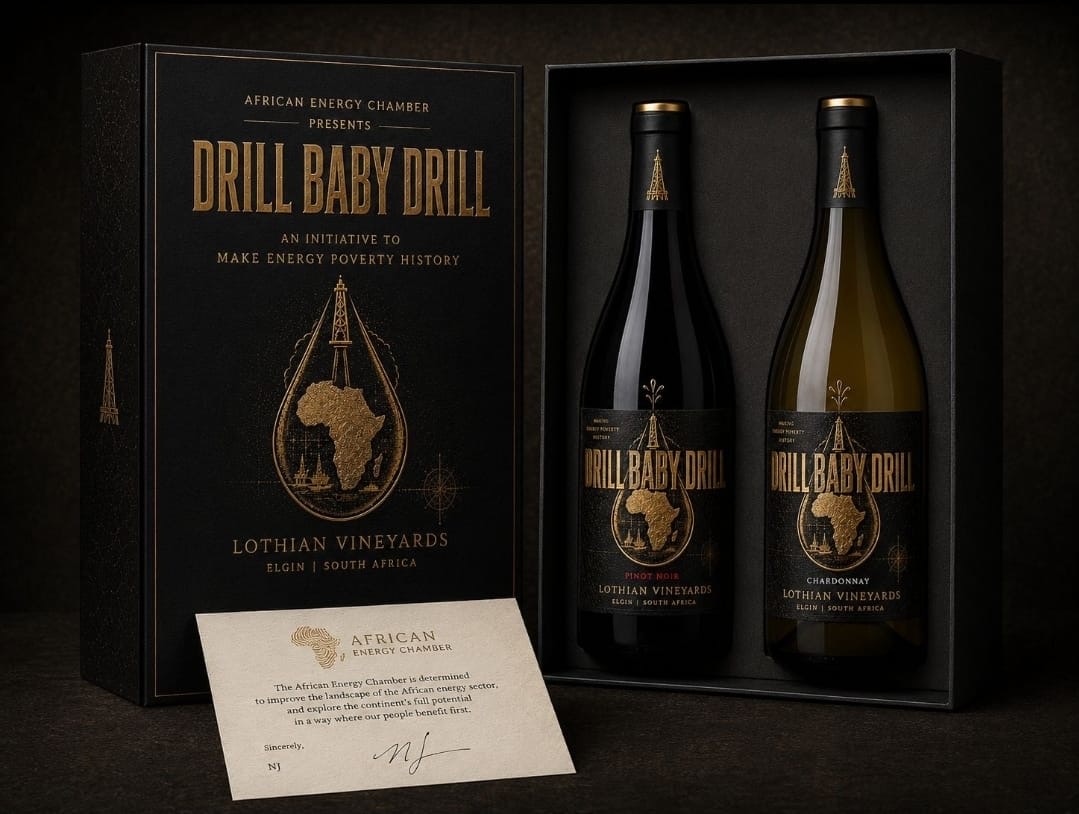
With 600 million Africans without electricity and 900 million without clean cooking solutions, Tim James has delivered the sort of column that mistakes a polished sentence for a sound argument. He has waved his arms at a bottle of wine as though he uncovered a national emergency, when all he has really done is bump into the machinery of modern life and act surprised that it has gears.
Diesel powers tractors and vineyard equipment. Electricity runs pumps, chillers, crushers, filtration systems, and refrigeration. Glass bottles are made in furnaces that burn serious energy. Labels, closures, cartons, cold storage, freight, and shipping all sit on top of an industrial chain that does not run on slogans and good intentions. The wine business is not a hymn; it is an energy-dependent enterprise. Anyone pretending otherwise is not making a serious critique. He is dressing up ignorance in a blazer.
And that is where the African Energy Chamber’s Drill Baby Drill wine lands with such satisfying force. It is a South African wine created in Elgin Valley, launched as a Chardonnay and Pinot Noir for the global community. That is not a gimmick. That is a statement of fact and pride. Africa produces. Africa builds. Africa deserves to celebrate the industries that power growth, jobs, trade, and ambition.
There is nothing shameful about that. On the contrary, there is something deeply honest about a wine that says out loud what the rest of the world prefers to mutter into its Chardonnay: oil and gas matter. Energy matters. Africa matters.
The numbers back that up, and numbers tend to have a bad habit of embarrassing the fashionable crowd. Wine is an energy-intensive product from vineyard to bottle to market. Life-cycle studies show that emissions come from diesel-powered field work, electricity use in wineries, refrigeration, bottle manufacturing, and distribution.
One study found an average footprint of 0.88 kg CO2e per 0.75 L bottle, with 44% tied to the glass bottle, 20% to diesel used by agricultural machines, and 32% to electricity consumption. Another study put still wine at about 1.05 kg CO2e per liter. A separate analysis found that packaging and transport account for 68% of the emissions in the average wine life cycle, with glass bottles the “elephant in the room”. In another assessment, glass production alone represented 45.6% of the winery’s carbon footprint. Those are not side issues. Those are the backbone of the product.
So when a critic sneers at a pro-energy wine, he is not exposing a hidden truth. He is describing the very system that makes the bottle possible. Wine does not get to market by moral outrage. It gets there by tractors, tanks, furnaces, trucks, ports, and fuel. That is the real economy, not the sermon economy.
Now, on the matter of expertise, a man can write elegantly and still not know what he is talking about. He can arrange a sentence like a maître d’ arranging silverware and still miss the whole meal. Wine criticism has value when it understands the vineyard, the cellar, the bottle, and the logistics chain behind the pour. It has less value when it ignores the industrial facts that make the bottle exist in the first place. A sharp turn of phrase is not the same thing as knowing how a sector works.
And let’s be honest, some folks can sniff a cork and mistake that for authority. They can use a fancy adjective, swirl the glass with conviction, and still remain light on the mechanics. That may play well in certain circles, but it does not make a person a reliable guide to an industry that depends on agriculture, manufacturing, transportation, and energy infrastructure.
That is what makes Drill Baby Drill so effective. It does not pretend that energy is an unfortunate footnote to civilization. It says the quiet part out loud: wine and energy are partners in the real world. It is also unapologetically African, which is precisely why it lands with such force. Africa does not need permission to celebrate abundance. It does not need to apologize for development. It does not need to hide behind imported guilt while trying to build real economies.
A South African wine that proudly honors the energy sector is not offensive. It is refreshing. It is authentic. It is the opposite of the endless scolding that so often passes for sophistication. To borrow a line fit for a porch in August: it is not trying to be a biscuit when it is plainly a steak.
That matters because energy is not a luxury item. It is the foundation of modern industry, modern trade, and modern life. The same is true across Africa, where energy access and industrial growth are inseparable from prosperity. If that reality bruises the sensibilities of some critics, the fault lies not in the bottle. The fault lies in the refusal to reckon with how the world actually works.
So let the record reflect this: the bottle is not ashamed. Africa is not ashamed. The people who grow the grapes, run the cellars, shape the glass, and move the product to market are not ashamed either. They are doing serious work in a serious economy.
If Tim James finds that inconvenient, he is entitled to his opinion. But he is not entitled to confuse opinion with expertise. A man can sound certain and still be wrong. He can sound learned and still be light on facts. And in this case, the bottle tells the truer story.
Wine is not made by sermonizing. It is made by energy, labor, and know-how. The African Energy Chamber understood that and said it plainly. The critic may call that provocative. The rest of us may call it honest. And in a world full of people pretending not to see the engine under the hood, honesty is a vintage worth keeping.
