
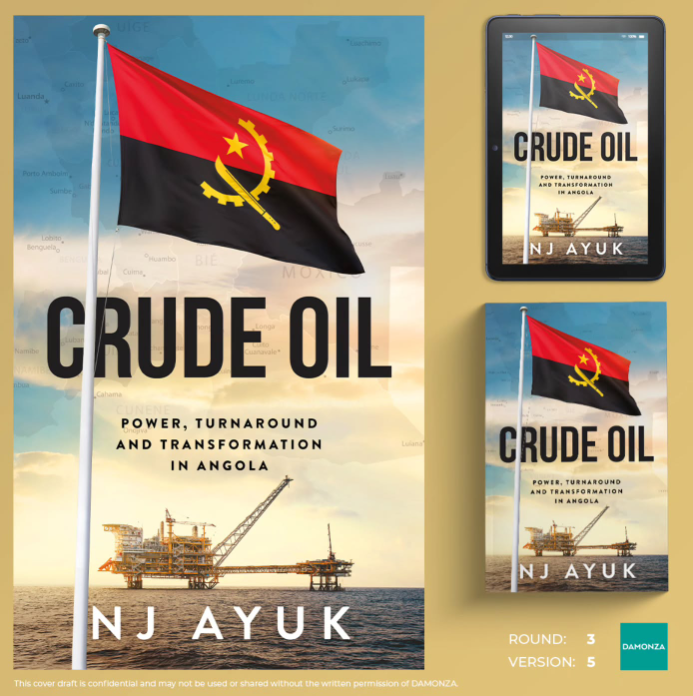
Angola’s oil sector has demonstrated how reform can transform a market on the cusp of rapid decline into an industry capable of attracting billions of dollars in investment. NJ Ayuk’s latest book titled Crude Oil: Power, Turnaround, and Transformation in Angola explores this transition, examining how targeted policy, structural reform and strategic leadership have turned the market around and placed Angola on a track toward growth, diversification and resilience.
Under the leadership of President João Manuel Gonçalves Lourenço and Diamantino Pedro Azevedo, Minister of Mineral Resources, Oil and Gas, the country embarked on a complete overhaul of the sector. Now, production is stabilizing, investment is rising and Angola’s oil industry is entering its most ambitious era yet. For other oil markets in Africa, Angola’s turnaround provides important lessons for countries looking to revitalize production through investor-focused reform and strategic policy.
Restructuring the Sector
Angola’s ability to curb production decline was largely attributed to changes implemented at a structural level. When President Lourenço took office in 2017, his administration focused on addressing the challenges that had plagued the oil industry over the years: lack of exploration and transparency. The government established an upstream regulator (the ANPG) and restructured the national oil company Sonangol.
The ANPG was tasked with overseeing the industry, therefore improving certainty, procedural clarity and licensing processes, while Sonangol was able to focus on its activities as an operator. As a result, Sonangol was able to expand its portfolio, work more closely with international partners and take steps toward a future IPO. For its part, the ANPG launched a multi-year licensing strategy, targeting 60 concessions, with 40 awarded to date.
Flexibility Brings Capital
Flexibility has been a significant investment driver in Angola. Under efforts to attract capital during times of market volatility, the government implemented its Permanent Offer Regime in 2021, allowing the country to proactively promote and negotiate concessions outside of traditional licensing structures. Blocks on permanent offer remain continuously available for companies to bid on, even after a round concludes. Between 2021 and 2023 alone, 27 blocks were awarded under this regime.
The country took it one step further, introducing policies targeting marginal fields and incremental production. Aimed at encouraging the development of fields considered less economically attractive, marginal field opportunities have created investment avenues for smaller independents, diversifying the country’s investment offering and supporting broader production growth.
The Incremental Production Decree – launched in 2024 – supports reinvestment in mature assets. Ayuk notes that the decree could enable the recovery of up to 500 million additional barrels of oil while extending the life of mature fields by up to 20 years. ExxonMobil made the first discovery under this decree in 2024 at the Likember-01 well at Block 15.
Diversification as a Strategic Priority
Angola’s success in revitalizing its hydrocarbon industry comes not from oil expansion alone, but from its ability to position natural gas as a strategic priority. With 11 trillion cubic feet of gas resources, the country has used reform to attract investment across the emerging gas value chain, supporting the transition from associated gas production to non-associated development.
While the Angola LNG plants has been operational since 2012, forays into non-associated development stand to strengthen feedstock, boost exports and strengthen the domestic gas market. A cornerstone of this shift was the Gas Monetization Law (2018) and Gas Master Plan (2025) – offering a clear blueprint for investing in the market. Since these policies, the New Gas Consortium brought the country’s first non-associated gas project online in 2026, while Azule Energy made the first dedicated gas discovery at Block 1/14.
Downstream Expansion and the IRDP
Angola’s turnaround transcends the upstream sector, with its commitment to strengthening its downstream market offering important lessons for African producers. With production stabilizing, the country moved to address its next challenge: refining. Despite producing above one million bpd, Angola imports 70% of its petroleum products.
To address this, the government established the Instituto Regulador dos Derivados do Petróleo and outlined goals to develop three new facilities beyond the operational Luanda plant – notably, Cabinda (operational since 2025), Lobito (seeking financing) and Soyo (in preparation). These moves reflect Angola’s broader strategy: capture more value domestically while reducing long-term dependence on imported fuels.
“Angola proved that African oil markets do not decline because resources disappear – they decline when policy becomes rigid, institutions weaken and investment loses confidence. What Angola achieved through reform, flexibility and political will is a lesson for every producing nation in Africa: if you create a competitive environment, capital will come, projects will move forward and production can recover,” states Ayuk.
