
By NJ Ayu, Executive Chairman of the African Energy Chamber
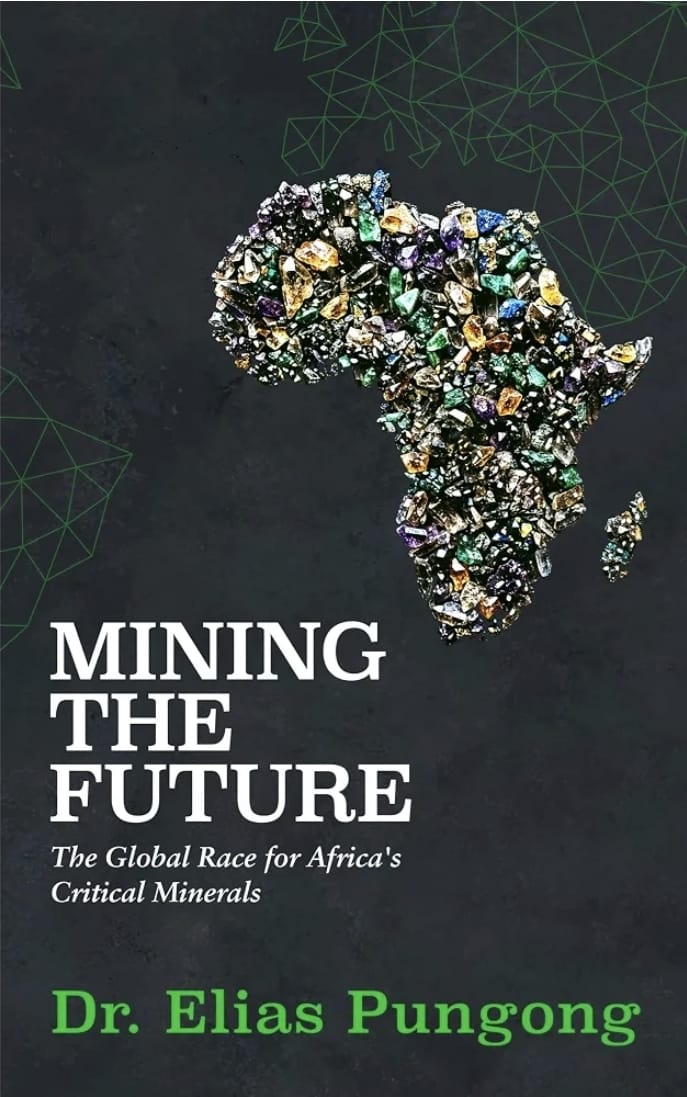
Some books enter the room quietly. Elias Pungong’s Mining the Future: The Global Race for Africa’s Critical Minerals kicks open the door wearing a hard hat, carrying a geological map, and asking a question plain enough for a courthouse yet consequential enough for an entire continent: Will Africa keep exporting its raw rocks, or will we finally build the industries those rocks can power?
That question is not measured in academic footnotes. It is measured in jobs, megawatts, industrial capacity, and whether Africa’s next resource boom builds lasting African prosperity or simply pads quarterly earnings reports in London, Beijing, and New York. Coming out of vital industry discussions during African Mining Week in Cape Town, one truth is undeniable: this opportunity is far too large for casual thinking and too critical for Africa to outsource to others.
Pungong, a Cameroonian business leader, chartered accountant, and veteran energy and mining adviser brings rare credibility to this debate. Having chaired the UK–Cameroon Chamber of Commerce and worked across global finance and African infrastructure, he speaks both the language of international capital and the language of local communities. He understands that a mine is never merely a hole in the ground with a balance sheet attached. Done right, it is a road, a transmission line, a training ground, and a foundation for sovereign industrial growth.
Nowhere is this more urgent than in the intensifying global race for Africa’s mineral wealth. Today, Sub-Saharan Africa holds nearly 30 percent of known global critical mineral reserves including roughly 80 percent of the world’s platinum-group metals, more than half of global cobalt and chromium, and at least a quarter of global manganese, bauxite, and graphite. From South Africa’s Bushveld Complex and the Copperbelt to Zimbabwe’s lithium pegmatites, Gabon’s manganese, and Mozambique’s graphite, the geology is settled.
Naturally, Washington, Beijing, and Brussels are scrambling for access. China has cemented an early lead through refining dominance and long-term infrastructure finance. The United States is countering with strategic diplomacy and development capital, exemplified by a reported $553 million U.S. Development Finance Corporation loan for the Lobito Corridor linking the DRC and Zambia to Angola’s Atlantic coast. Europe, meanwhile, is pushing hard for diversified, traceable supply chains.
This geopolitical competition gives Africa tremendous leverage provided we refuse to act as a passive warehouse. African nations must not be forced to pick a single foreign patron. Instead, we must negotiate like seasoned dealmakers, demanding enforceable contracts that guarantee local content, technology transfer, transparent taxation, and domestic value creation. The world is competing for Africa’s minerals; Africa must compete for the best terms.
Consider the financial stakes. While the global market for refined energy-transition minerals topped $230 billion in 2024, domestic processing and refining could expand Africa’s critical-minerals market from $70 billion to $120 billion by 2040. That $50 billion surge a 71 percent increase does not even account for the downstream multiplier effects in engineering, logistics, and local procurement. Yet with global critical-minerals investment growth cooling to 5 percent in 2024 and exploration plateauing, geology alone will not close deals. Mineral wealth attracts attention, but only bankable projects attract capital.
Capturing that capital requires disciplined beneficiation processing and refining minerals on African soil before they ever touch an export vessel. Whether it is spherical graphite in East Africa, high-purity manganese sulphate in South Africa and Gabon, purified phosphoric acid in Morocco, or processed copper and cobalt in the DRC and Zambia, the commercial pathways are clear. Still, beneficiation cannot be treated as a political ribbon-cutting exercise. Not every country can build every link of the supply chain alone; success demands regional integration, shared corridors, and harmonized trade policies.
Above all, we must confront an inescapable reality: Africa cannot manufacture the future on an unreliable grid. According to the African Energy Chamber’s State of African Energy 2025 Outlook, continental electricity generation is projected to rise from 980 terawatt-hours to nearly 1,400 terawatt-hours by 2030, driven by $47 billion in projected energy investment. Yet more than 600 million Africans still lack access to electricity. Smelters, refineries, and rail corridors cannot run on press releases or intermittent power. That is why Africa must responsibly develop its natural gas resources alongside renewables to provide the firm, reliable baseload electricity required for heavy industry.
Encouragingly, major capital commitments from the $1.8 billion Orion Critical Mineral Consortium and Gabon’s proposed $2 billion Mabounié rare-earths project to Zimbabwe’s Mapinga lithium refinery and Namibia’s green iron initiative show that execution is beginning to replace rhetoric.
Elias Pungong has delivered a timely, clear-eyed blueprint for policymakers and investors alike. Geology gave Africa the endowment, but policy, power, and discipline will determine our destiny. A mining project is not a success simply because ore leaves the ground; it is a success only when lasting opportunity stays behind.
